
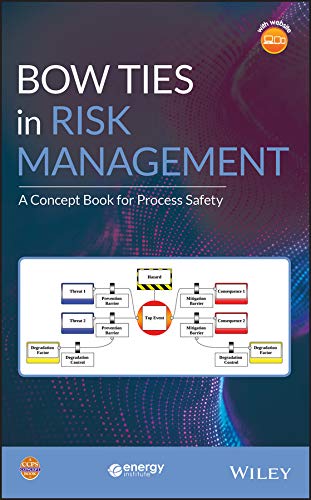
Bow ties in risk management : a concept book for process safety / Center For Chemical Process Safety of The American Institute Of Chemical Engineers, New York, NY, and Energy Institute, London, UK.
Material type: TextSeries: CCPS concept bookPublisher: Hoboken, NJ : John Wiley & Sons, Inc. ; [New York, NY] : American Institute of Chemical Engineers, 2018Copyright date: ©2018Description: 1 online resource (xv, 357 pages)Content type:
 - text
- computer
- online resource
- 9781119490388
- 1119490383
- 9781119490357
- 1119490359
- 9781119490340
- 1119490340
- Bowties in risk management
- 660/.2804 23
- TP150.S24 B69 2018
Includes bibliographical references and index.
"Explains how to construct bow ties of high practical value for operationalizing barriers, avoiding common pitfalls, with realistic examples -Explains how to treat human and organizational factors in a sound and practical manner -Proposes a standardization of terminology and definitions associated with bow ties by drawing on a wealth of industry experience from well-known experts -Explains how to apply the bow tie method to create high value organizational learning from incidents and audits -Explains the practical application and value of bow ties in plant management and active risk management, from the control room to the board room Marketing Description: -Members of: AIChE, CCPS, ISA, ASME, ASSE, ACS, AIHA, OSHA, ICMA, European Process Safety Centre (EPSC), American Chemistry Council (ACC) -Members of trade associations such as API, NPRA, ACC and SOCMA in the US and similar associations around the world -Readers of: Journals of the societies mentioned above, Chemical Engineering, Chemical Engineering Progress, C&E News"-- Provided by publisher.
Intro; BOW TIES IN RISK MANAGEMENT; CONTENTS; LIST OF TABLES; LIST OF FIGURES; ACRONYMS AND ABBREVIATIONS; GLOSSARY; ACKNOWLEDGMENTS; ONLINE MATERIALS ACCOMPANYING THIS BOOK; PREFACE; 1 INTRODUCTION; 1.1 PURPOSE; 1.2 SCOPE AND INTENDED AUDIENCE; 1.3 ORGANIZATION OF THIS CONCEPT BOOK; 1.4 INTRODUCTION TO THE BOW TIE CONCEPT; 1.4.1 Reason's Swiss Cheese, Models of Accident Causation and Bow Ties; 1.4.2 History and Regulatory Context of Bow Ties; 1.4.3 What Bow Ties Address; 1.4.4 Key Elements of a Bow Tie; 1.4.5 Benefits of Bow Ties; 1.4.6 Linkage between Bow Ties, Fault Trees, and Event Trees
1.5 CONCLUSIONS2 THE BOW TIE MODEL; 2.1 BOW TIE MODEL ELEMENTS; 2.2 HAZARD; 2.2.1 Hazard: Characteristics; 2.2.2 Formulating the Hazard; 2.2.3 Hazard Examples; 2.3 TOP EVENT; 2.3.1 Top Event: Characteristics; 2.3.2 Formulating the Top Event; 2.3.3 Top Event Examples; 2.4 CONSEQUENCES; 2.4.1 Consequences: Characteristics; 2.4.2 Formulating Consequences; 2.4.3 Consequence Examples; 2.5 THREATS; 2.5.1 Threats: Characteristics; 2.5.2 Formulating Threats; 2.5.3 Threat Examples; 2.6 BARRIERS; 2.6.1 Barriers: Concept and Location on Bow Tie; 2.6.2 Barriers: Type and Characterization
2.6.3 Barrier Properties2.6.4 Metadata; 2.6.5 Barrier Examples; 2.7 DEGRADATION FACTORS AND DEGRADATION CONTROLS; 2.7.1 Degradation Factors: Characteristics; 2.7.2 Degradation Controls: Concept and Location on Bow Tie; 2.7.3 Use Degradation Factors and Degradation Controls Sparingly; 2.7.4 Degradation Factors and Degradation Control Examples; 2.7.5 The Level of Detail Should Match the Goal and Audience of the Bow Tie; 2.8 CONCLUSIONS; 3 BOW TIE DEVELOPMENT; 3.1 RATIONALE FOR BOW TIE DEVELOPMENT; 3.2 BOW TIE WORKSHOP; 3.2.1 Bow Tie Workshop Pre-Work; 3.2.2 Workshop Team
3.2.3 The Bow Tie Workshop3.3 POST-BOW TIE WORKSHOP ACTIVITIES AND QUALITY CHECKS; 3.4 CONCLUSIONS; 4 ADDRESSING HUMAN FACTORS IN BOW TIE ANALYSIS; 4.1 HUMAN AND ORGANIZATIONAL FACTORS FUNDAMENTALS; 4.1.1 Introduction; 4.1.2 Human and Organizational Factors -- Conventional Approach; 4.1.3 Human and Organizational Factors -- New Paradigm; 4.1.4 Human Failure as a Degradation Factor; 4.2 STANDARD AND MULTI-LEVEL BOW TIE APPROACHES; 4.2.1 Standard Bow Tie Approach; 4.2.2 'Multi-Level Bow Tie' Extension; 4.2.3 Comparison of Multi-Level and Generic Human Factors Bow Ties
4.3 HUMAN AND ORGANIZATIONAL FACTORS AS A BARRIER OR DEGRADATION CONTROL4.3.1 Barriers; 4.3.2 Degradation Controls; 4.3.3 Training and Competence; 4.4 VALIDATING HUMAN PERFORMANCE IN BARRIERS AND DEGRADATION CONTROLS; 4.5 QUANTIFYING HUMAN RELIABILITY IN BOW TIES; 4.6 CONCLUSIONS; 5 PRIMARY USES OF BOW TIES; 5.1 PRIMARY USE EXAMPLES; 5.2 LINKING BOW TIES TO THE RISK MANAGEMENT SYSTEM; 5.2.1 Uses for Bow Ties -- Design Verification; 5.2.2 Uses for Bow Ties -- Communication and Management of Barriers and Degradation Controls; 5.2.3 Uses for Bow Ties -- Risk Management during Operations
Description based on online resource; title from digital title page (viewed on October 12, 2018).
There are no comments on this title.