
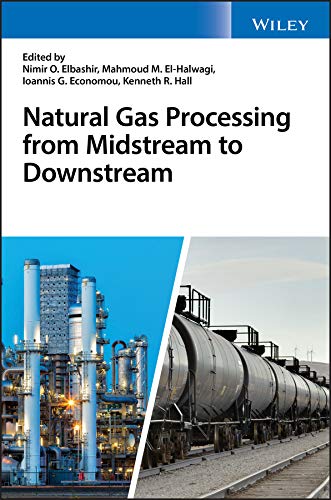
Natural gas processing from midstream to downstream / edited by Nimir O. Elbashir, Mahmoud M. El-Halwagi, Ioannis G. Economou, Kenneth R. Hall.
Material type: TextPublisher: Hoboken, NJ : John Wiley & Sons, Inc, 2019Copyright date: ©2019Description: 1 online resource (xxviii, 556 pages)Content type:
 - text
- computer
- online resource
- 9781119269632
- 1119269636
- 9781119269618
- 111926961X
- 9781119269625
- 1119269628
- 665.7/3 23
- TP350 .N36456 2019
Includes bibliographical references and index.
Cover; Title Page; Copyright; Contents; List of Contributors; About the Editors; Preface; Chapter 1 Introduction to Natural Gas Monetization; 1.1 Introduction; 1.2 Natural Gas Chain; 1.3 Monetization Routes for Natural Gas; 1.3.1 Large Industries and Power Plants; 1.3.2 Small/Medium Industries and Commercial Users; 1.3.3 Residential; 1.3.4 Natural Gas Export; 1.3.4.1 Pipeline Export; 1.3.4.2 Liquefied Natural Gas (LNG); 1.4 Natural Gas Conversion to Chemicals and Fuels; 1.5 Summary; Acknowledgment; References
Chapter 2 Techno-Economic Analyses and Policy Implications of Environmental Remediation of Shale Gas Wells in the Barnett Shales2.1 Introduction; 2.1.1 Framing the Issues: The Energy and Environmental Equation; 2.1.2 Well Lifecycle Analysis and Environmental Impacts; 2.2 Shale Gas Operations; 2.2.1 Summary of Shale Gas Operations; 2.2.2 Hydraulic Fracturing and Water Impacts; 2.2.2.1 Fresh Water Consumption; 2.2.2.2 Transportation and Disposal of Produced Water; 2.2.3 Fuel Usage; 2.2.4 Seismicity and Seismic Implications; 2.3 The Barnett Shale
2.4 Environmental Remediation of Greenhouse Gas Emissions Using Natural Gas as a Fuel2.4.1 Single Fuel, Bi-Fuel, or Dual Fuel; 2.4.2 Forms of Natural Gas; 2.4.3 Environmental Impact; 2.5 Environmental Remediation of Water and Seismic Impacts; 2.5.1 Waterless Fracturing; 2.5.1.1 Liquefied Petroleum Gas Fracturing; 2.5.1.2 Carbon Dioxide Fracturing; 2.5.2 Recycling Produced Water; 2.5.2.1 Fracturing with Produced Water; 2.5.2.2 Treating Wastewater; 2.6 Theoretical Calculations; 2.6.1 Current Operations; 2.6.1.1 Key Assumptions; 2.6.1.2 Fuel Usage by Well; 2.6.1.3 Annual Fuel Usage and Costs
2.6.1.4 Greenhouse Gas Emissions from Fuel Burn2.6.1.5 Hydraulic Fracturing Impacts; 2.6.2 Operations after Environmental Remediation of Greenhouse Gases; 2.6.2.1 Conversion to Dual Fuel Systems; 2.6.2.2 Environmental Improvements; 2.6.3 Operations after Environmental Remediation of Hydraulic Fracturing; 2.6.3.1 Waterless Fracturing; 2.6.3.2 Environmental Improvements; 2.6.4 Net Present Value and Expected Capital Outlay; 2.7 Results and Discussion; 2.7.1 Improved Operations with Environmental Remediation of Greenhouse Gas Emissions; 2.7.1.1 Capital Investment Analysis
2.7.1.2 Broader Economic and Environmental Benefits2.7.2 Improved Operations with Alternative Fracturing Fluids; 2.7.2.1 Cost of Alternative Fracturing Fluids; 2.7.2.2 Availability of Salt Water Disposal Sites; 2.7.2.3 Fracturing with CO2 vs. LPG; 2.7.2.4 Flowback and Recycling of Fracturing Fluid; 2.7.2.5 Seismic Implications; 2.7.2.6 Unlocking Arid and Water Sensitive Shales; 2.7.2.7 Broader Economic and Environmental Benefits; 2.7.3 Environmental and Microeconomic Impacts of Combined Technology Alternatives; 2.8 Opportunities for Future Research; References
Description based on online resource; title from digital title page (viewed on January 15, 2019).
There are no comments on this title.