
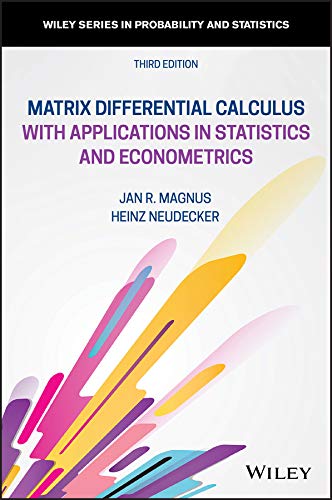
Matrix differential calculus with applications in statistics and econometrics / Jan R. Magnus and Heinz Neudecker.
Material type: TextSeries: Wiley series in probability and statisticsPublisher: Hoboken, NJ : John Wiley & Sons, Inc., 2019Copyright date: ©2019Edition: Third editionDescription: 1 online resourceContent type:
 - text
- computer
- online resource
- 9781119541196
- 1119541190
- 9781119541219
- 1119541212
- 9781119541165
- 1119541166
- 512.9/434 23
- QA188 .M34 2019
Includes bibliographical references and indexes.
Cover; Title Page; Copyright; Contents; Preface; Part One -- Matrices; Chapter 1 Basic properties of vectors and matrices; 1 Introduction; 2 Sets; 3 Matrices: addition and multiplication; 4 The transpose of a matrix; 5 Square matrices; 6 Linear forms and quadratic forms; 7 The rank of a matrix; 8 The inverse; 9 The determinant; 10 The trace; 11 Partitioned matrices; 12 Complex matrices; 13 Eigenvalues and eigenvectors; 14 Schur's decomposition theorem; 15 The Jordan decomposition; 16 The singular-value decomposition; 17 Further results concerning eigenvalues
18 Positive (semi)definite matrices19 Three further results for positive definite matrices; 20 A useful result; 21 Symmetric matrix functions; Miscellaneous exercises; Bibliographical notes; Chapter 2 Kronecker products, vec operator, and Moore-Penrose inverse; 1 Introduction; 2 The Kronecker product; 3 Eigenvalues of a Kronecker product; 4 The vec operator; 5 The Moore-Penrose (MP) inverse; 6 Existence and uniqueness of the MP inverse; 7 Some properties of the MP inverse; 8 Further properties; 9 The solution of linear equation systems; Miscellaneous exercises; Bibliographical notes
Chapter 3 Miscellaneous matrix results1 Introduction; 2 The adjoint matrix; 3 Proof of Theorem 3.1; 4 Bordered determinants; 5 The matrix equation AX = 0; 6 The Hadamard product; 7 The commutation matrix Kmn; 8 The duplication matrix Dn; 9 Relationship between Dn+1 and Dn, I; 10 Relationship between Dn+1 and Dn, II; 11 Conditions for a quadratic form to be positive (negative) subject to linear constraints; 12 Necessary and sufficient conditions for r(A : B) = r(A) + r(B); 13 The bordered Gramian matrix; 14 The equations X1A + X2B′ = G1,X1B = G2; Miscellaneous exercises; Bibliographical notes
Part Two -- Differentials: the theoryChapter 4 Mathematical preliminaries; 1 Introduction; 2 Interior points and accumulation points; 3 Open and closed sets; 4 The Bolzano-Weierstrass theorem; 5 Functions; 6 The limit of a function; 7 Continuous functions and compactness; 8 Convex sets; 9 Convex and concave functions; Bibliographical notes; Chapter 5 Differentials and differentiability; 1 Introduction; 2 Continuity; 3 Differentiability and linear approximation; 4 The differential of a vector function; 5 Uniqueness of the differential; 6 Continuity of differentiable functions
7 Partial derivatives8 The first identification theorem; 9 Existence of the differential, I; 10 Existence of the differential, II; 11 Continuous differentiability; 12 The chain rule; 13 Cauchy invariance; 14 The mean-value theorem for real-valued functions; 15 Differentiable matrix functions; 16 Some remarks on notation; 17 Complex differentiation; Miscellaneous exercises; Bibliographical notes; Chapter 6 The second differential; 1 Introduction; 2 Second-order partial derivatives; 3 The Hessian matrix; 4 Twice differentiability and second-order approximation, I
Online resource; title from digital title page (viewed on June 21, 2019).
A brand new, fully updated edition of a popular classic on matrix differential calculus with applications in statistics and econometrics This exhaustive, self-contained book on matrix theory and matrix differential calculus provides a treatment of matrix calculus based on differentials and shows how easy it is to use this theory once you have mastered the technique. Jan Magnus, who, along with the late Heinz Neudecker, pioneered the theory, develops it further in this new edition and provides many examples along the way to support it. Matrix calculus has become an essential tool for quantitative methods in a large number of applications, ranging from social and behavioral sciences to econometrics. It is still relevant and used today in a wide range of subjects such as the biosciences and psychology. Matrix Differential Calculus with Applications in Statistics and Econometrics, Third Edition contains all of the essentials of multivariable calculus with an emphasis on the use of differentials. It starts by presenting a concise, yet thorough overview of matrix algebra, then goes on to develop the theory of differentials. The rest of the text combines the theory and application of matrix differential calculus, providing the practitioner and researcher with both a quick review and a detailed reference. Fulfills the need for an updated and unified treatment of matrix differential calculus Contains many new examples and exercises based on questions asked of the author over the years Covers new developments in field and features new applications Written by a leading expert and pioneer of the theory Part of the Wiley Series in Probability and Statistics Matrix Differential Calculus With Applications in Statistics and Econometrics Third Edition is an ideal text for graduate students and academics studying the subject, as well as for postgraduates and specialists working in biosciences and psychology.
Copyright © 2019 by John Wiley & Sons 2019
There are no comments on this title.