
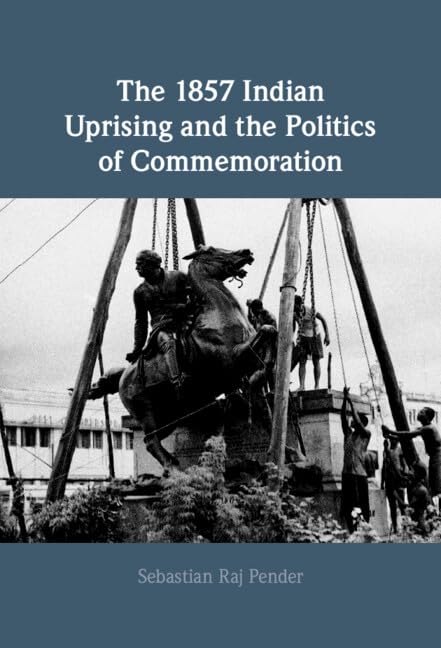
The 1857 Indian uprising and the politics of commemoration / bySebastian Raj Pender, University of Oxford.
Material type: TextPublisher: Cambridge ; New York, NY : Cambridge University Press, 2022Description: pages cmContent type:
 - text
- unmediated
- volume
- 9781316511336
- War memorials -- India -- History
- Collective memory -- India -- History -- 21st century
- Public opinion -- India
- HISTORY / Asia / India & South Asia
- India -- History -- Sepoy Rebellion, 1857-1858 -- Anniversaries, etc
- Lucknow (India) -- History -- Siege, 1857 -- Anniversaries, etc
- Great Britain -- Colonies -- Public opinion -- History
- India -- Politics and government -- 1765-1947 -- Public opinion
- 954.03/17 23/eng/20211208
| Item type | Current library | Collection | Call number | Status | Date due | Barcode | |
|---|---|---|---|---|---|---|---|
 Books
Books
|
Prof. Ram Dayal Munda Central Library, IGNTU Amarkantak M.P. General Stacks | History | 954.03/17 (Browse shelf(Opens below)) | Available | 89860 | ||
|
Books
|
Prof. Ram Dayal Munda Central Library, IGNTU Amarkantak M.P. General Stacks | History | 954.03/17 (Browse shelf(Opens below)) | Available | 89861 |
Includes bibliographical references and index.
Meaning, Memory, Monument -- "Remember Cawnpore!": British Counterinsurgency and the Memory of Massacre -- "Forget Cawnpore!": Commemorating the Mutiny, 1857-77 -- Negotiating Fear: Celebration, Commemoration and the "Mutiny Pilgrimage" -- The Mutiny of 1907: Anxiety and the Mutiny's Golden Jubilee -- The War of Indian Independence: A Struggle for Meaning, Memory, and the Right to Narrate -- Remembering the Mutiny at the End of Empire: 1947-1972 -- Celebrating the First War of Independence Today: Caste, Gender, Religion -- Memories of the Present and Echoes of the Past.
"The Cawnpore Well, Lucknow Residency, and Delhi Ridge were sacred places within the British imagination of India. Sanctified by the colonial administration in commemoration of victory over the 'Sepoy Mutiny of 1857', they were read as emblems of empire which embodied the central tenets of sacrifice, fortitude, and military prowess that underpinned Britain's imperial project in the late nineteenth century. So central were these locations to British conceptions of India that Brigadier H. Bullock, head of the Graves and Monuments Section of the British High Commission, could still note their overwhelming significance as late as 1948. Writing specifically about the Cawnpore Well, Bullock claimed that it was still seen as 'hallowed ground' and was 'one of the few things in India that every Briton has heard of'. Whilst these sites acted as nodal points within colonial discourse they have gradually been incorporated into India's national story. The Lucknow Residency, for example, was designated a site of national importance in a ceremony marking the 25th anniversary of Indian Independence in 1972, during which the Residency was 'declared to be saturated with the blood of the Indian Martyrs, who had thus laid the First Foundation of the Freedom Fight, discounting the erstwhile belief that it was reminiscent of British Glory'. Rededicated in honour of what is now officially known in India as the First War of Independence, and thus sacred to the memory of those who revolted against colonial rule, rather than those who saved it, the Cawnpore Well, Lucknow Residency, and Delhi Ridge are today proud signifiers of Indian nationalism"-- Provided by publisher.
There are no comments on this title.